When Not To Go Kayaking On Sydney Harbour?
The conditions that cancel or spoil a Sydney Harbour kayak tour: operator weather rules, ferry traffic, event closures, darkness and the myths that are not real safety rules.
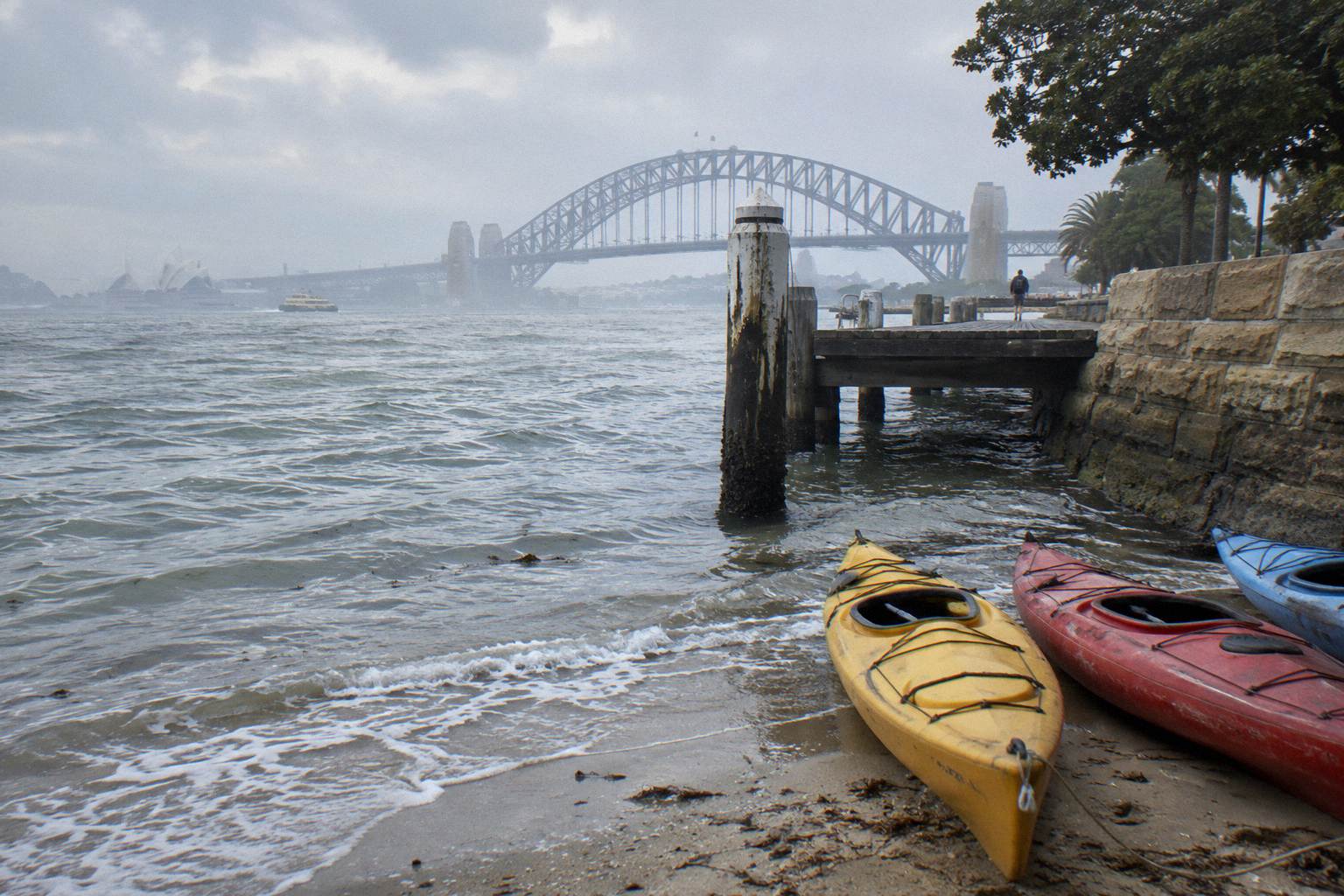
In short: A harbour paddle should not go ahead in strong winds, thunderstorms or lightning, dangerous water or poor visibility, and Sydney Harbour Kayaks, a Middle Harbour operator, cancels its tours for exactly those conditions while running them in light rain. Beyond weather, the times to avoid are heavy ferry traffic, event closure periods, and any trip after dark without a proper light. The 120 rule is not an official standard and should not drive your decision.
For the full picture of paddling the harbour generally, see the kayaking Sydney Harbour overview.
| Quick fact | Detail |
|---|---|
| Weather that cancels tours | Strong winds, thunderstorms or lightning, dangerous water, poor visibility, per Sydney Harbour Kayaks' own policy |
| Weather that does not | Light rain: tours proceed |
| After dark | Paddlecraft must carry a torch or lantern showing a white light, per NSW rules |
| Event closures | Vivid, New Year's Eve and Australia Day change closures each year; check the current Transport for NSW map |
| Harbour authority phone | Transport for NSW Maritime, 13 12 36 |
| Myth to ignore | The 120 rule has no official standing |
Skip kayaking on Sydney Harbour when a named operator would cancel for weather, meaning strong wind, thunderstorms or lightning, dangerous water, or poor visibility, though light rain alone does not count. Also stay off the water during peak ferry traffic while big ships are moving, around harbour event closures, and after sunset unless you carry the white light NSW maritime rules require. The harbour is what Transport for NSW calls an extremely busy waterway, and the rules that govern it are written for that reality.
“Both the entry into the water and the safety instructions were clear and straightforward for everyone. Once in the water, there was more than one guide, not only to lead the way but also to take photos of you.”
The practical starting point is what a tour operator itself will and will not run. Sydney Harbour Kayaks, which paddles Middle Harbour from The Spit, publishes its own policy: tours proceed in light rain and are cancelled for strong winds, thunderstorms or lightning, dangerous water and poor visibility. That is a useful benchmark even for a tour run by a different operator, because it tells you the kinds of conditions a professional guide treats as unacceptable on Sydney water. A company that runs guided paddles for a living, in double sea kayaks, with qualified guides, is not cancelling for fun; those conditions genuinely change the risk. To see how those cancellation rules fit the bigger picture, the guide to sea kayaking Sydney Harbour covers what the activity actually involves, from the craft and gear to how guided trips differ from casual harbour paddles.
The second layer is traffic. NSW's harbour rules tell paddlers to keep to the starboard side of shipping channels and well clear of big ships, and they note that high-speed ferries display an all-round yellow flashing light. A paddle planned around the middle of a busy summer day shares the water with far more of that traffic than a dawn or evening one. That is not a reason to stay home, but it is a reason to pick your window and your route with the best time to kayak Sydney Harbour in mind.
The third layer is your own readiness. If you cannot swim confidently, feel unwell, or are paddling with a child who is not up to the distance, the honest answer to "when not to go" includes "not today, not on this route". Guidance from the American Canoe Association describes sit-on-top kayaks as suitable entry-level craft on calm, protected water, and that is the environment a guided harbour tour is designed around, not rough open conditions.
What Weather Actually Cancels A Harbour Tour?
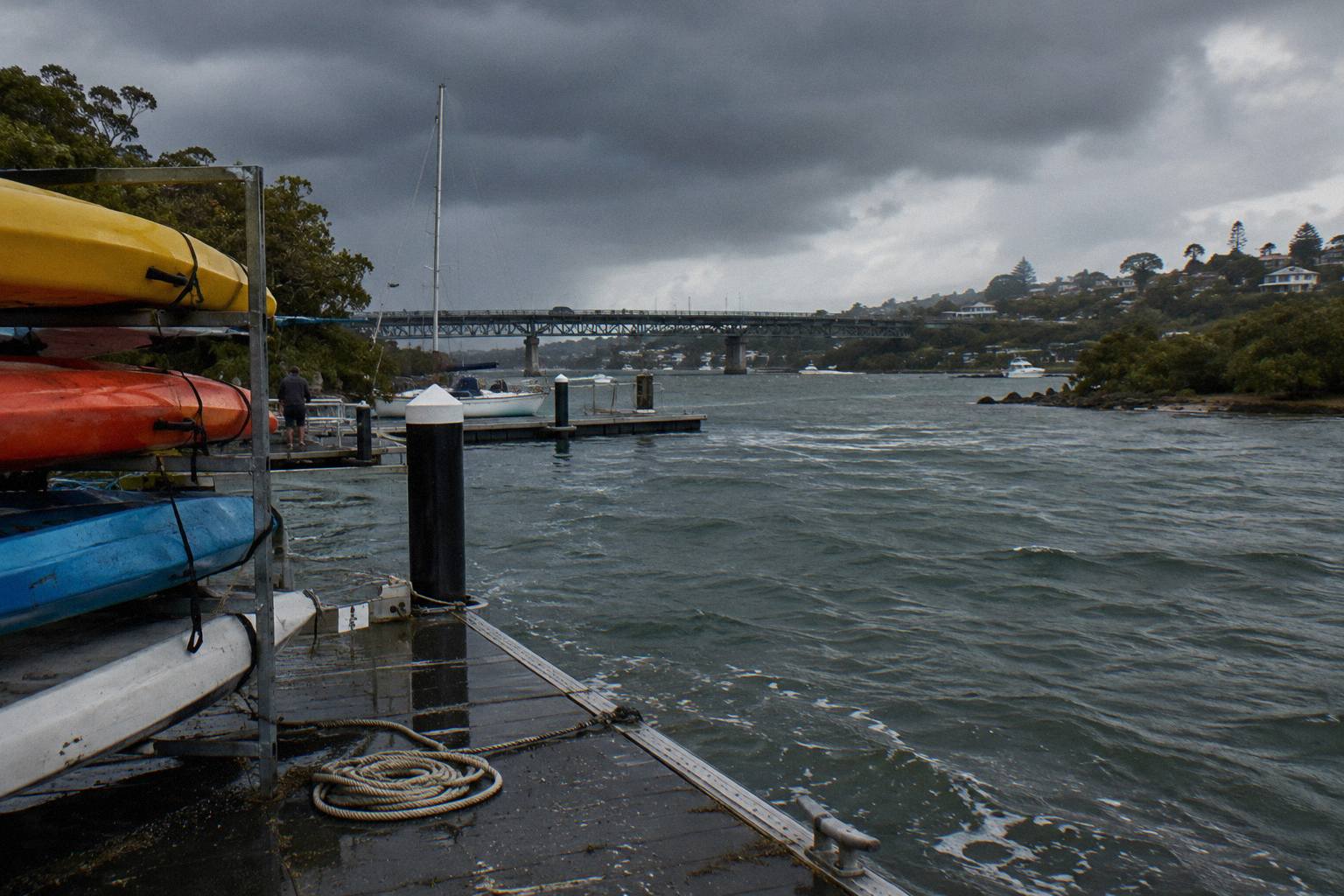
Sydney Harbour Kayaks runs its tours in light rain and cancels them only for strong winds, thunderstorms or lightning, dangerous water and poor visibility, which makes it the most specific published weather standard among Sydney guided kayak tours, though it applies to that operator alone. No official wind-speed or temperature threshold exists for cancelling a paddle, so read the terms attached to your exact booking before you go.
The same operator page adds the details around the edges. Arrive 15 minutes before departure; late arrivals are treated as no-shows. Public tours generally need a minimum of four participants, otherwise the operator offers a reschedule, an alternative or a cancellation. And if the operator itself cancels a direct booking, the guest chooses a transfer, a three-year credit or a full refund with no admin fee.
| Condition | What Sydney Harbour Kayaks says |
|---|---|
| Light rain | Tours proceed |
| Strong winds | Tours cancelled |
| Thunderstorms or lightning | Tours cancelled |
| Dangerous water | Tours cancelled |
| Poor visibility | Tours cancelled |
| Fewer than 4 participants on a public tour | Reschedule, alternative tour or cancellation offered |
Guest-side cancellation terms from the same operator page, again for direct bookings: cancel more than 7 days before and you get a refund less an AUD 15 per person admin fee, or a free transfer or credit; between 24 hours and 7 days there is no refund but a free transfer or credit; inside 24 hours and for no-shows, nothing. Private and corporate bookings have their own ladder: refunds more than 14 days out, transfer or credit only between 48 hours and 14 days, nothing under 48 hours. Full payment is taken at booking.
Two honest caveats. First, these are the operator's direct-booking terms; the booking-page terms for a tour you book through an agent may differ, so read the terms attached to your actual booking. Second, no wind-speed or temperature threshold appears in any official NSW source for kayaks, so treat anyone quoting you one as quoting a rule that does not exist. If a storm is forecast, the practical move is covered in what happens when a tour is cancelled for weather.
Should You Paddle When Ferries And Ships Are Thick?
NSW rules describe Sydney Harbour as an extremely busy waterway and tell paddlers to keep to the starboard side of shipping channels and well clear of big ships. The times to avoid are the busy daytime windows when ferries, cruise movements and recreational boats stack up, and any moment a large vessel is near your line. No vessel may cross in front of a large ship or obstruct it in a channel, and that includes you in a kayak.
The rules also give you tools for reading the water. High-speed ferries display an all-round yellow flashing light, which is the single most useful thing to know when a fast vessel is approaching from behind or across. Sydney VTS, the harbour's vessel traffic service, broadcasts on VHF channels 16 and 13 every two hours, which matters if you paddle with a radio on an organised group trip. For everything else, the Transport for NSW Maritime phone number is 13 12 36.
Personal watercraft and kiteboards are banned on the harbour, including Middle Harbour; that ban does not apply to kayaks, but it tells you the authority's view of which craft belong on this water and which do not. Event closures are the other big traffic factor: Vivid, New Year's Eve and Australia Day change harbour closures every year, and the specifics exist only as annual Transport for NSW maps. Print nothing from memory; check the current map before you plan a paddle around any of those dates.
A reasonable person reading this might wonder whether the harbour is simply too busy to paddle at all. It is not, but the honest framing is that route and timing do more work than nerve. Paddles that start at Lavender Bay, Kirribilli, Rushcutters Bay or The Spit are planned by operators who work around the ferry lines every day, and sheltered water such as Middle Harbour or Pittwater removes most of the large-vessel question entirely.
Why Is Paddling After Dark Different?
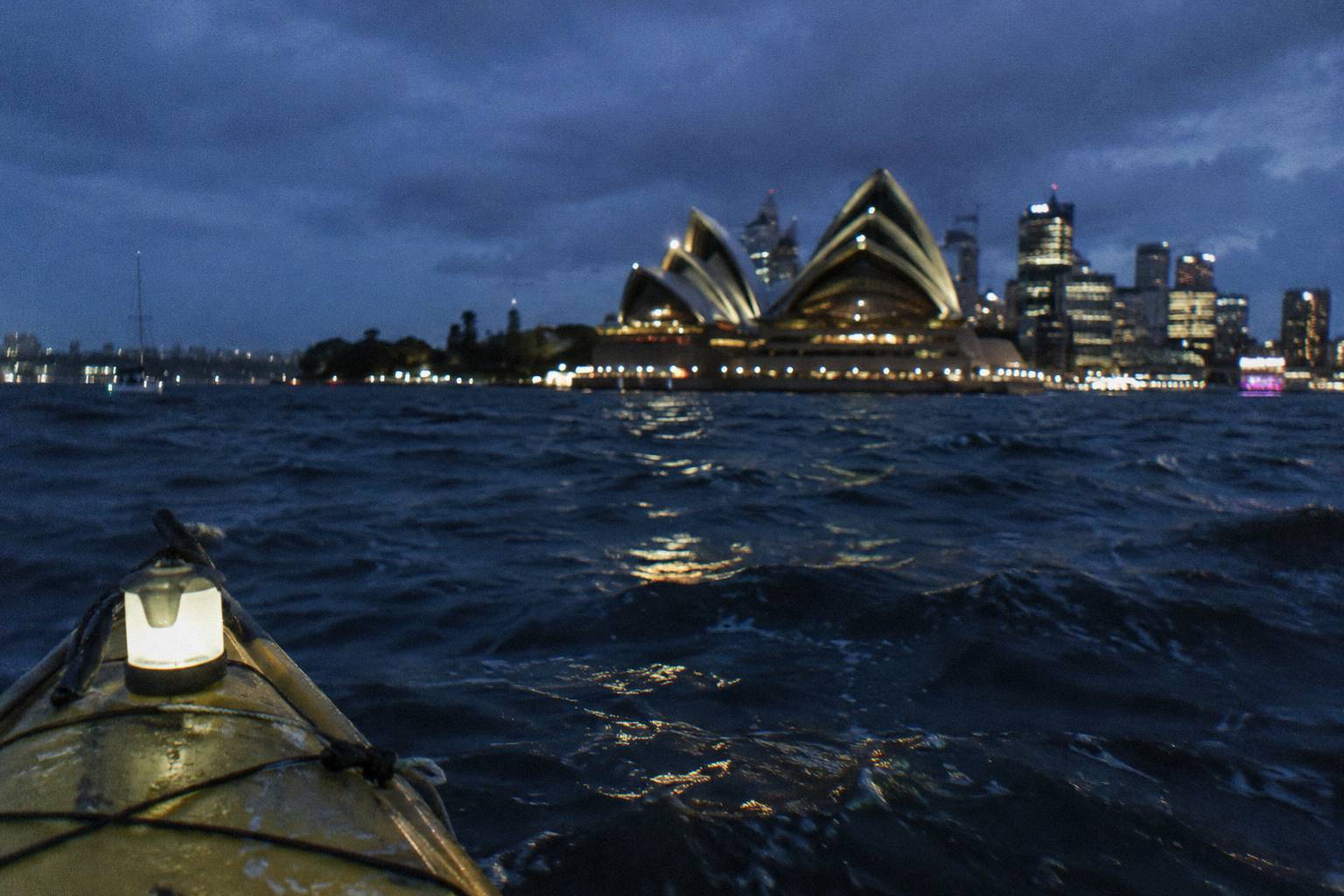
Paddling after dark is different because the rules and the risks both change. NSW paddlecraft, meaning kayaks, canoes and surf skis, must carry a torch or lantern showing a white light, ready in time to prevent a collision, with a head torch recommended, and in enclosed waters such as Sydney Harbour a lifejacket rated Level 50S or above must be worn between sunset and sunrise, just as it must be worn when paddling alone.
The full lifejacket wording is worth knowing rather than paraphrasing. Vessels must carry enough approved lifejackets for everyone on board at all times. For canoes and kayaks in enclosed waters, a lifejacket must be worn when the paddler is alone, including with children under 12 aboard, or at night. In open waters and when crossing coastal bars it must be worn at all times. NSW adds a plain recommendation: wear one at all times. A skipper can also require lifejackets in heightened-risk situations such as a severe weather warning, non-swimmers on board, cold water or a danger of swamping. Guided and rental operators issue lifejackets; Sydney Harbour Kayaks includes an approved lifejacket in its rentals and says children always wear one.
The reason this belongs in a "when not to go" discussion is simple: unguided night paddling is the scenario where a small mistake compounds. A paddler who is hard to see in daylight is close to invisible after dark without a light. If the night-paddle idea appeals, the safer version is a guided product built for it; the night kayak Sydney options include LED-lit tours run by operators who carry the lighting and the group control for you. The NSW lifejacket requirements and the lights paddlecraft must display are both on the nsw.gov.au site.
Do Tides And Currents Ever Say No?
Yes, they can, and sea kayakers gauge that with the 50/90 rule, a tidal-stream estimate from coastal navigation teaching rather than a safety law. It puts current speed near zero at slack water, at roughly 50 percent of maximum after the first hour, about 90 percent after the second, and 100 percent at the third, per TideTime's explanation, a planning aid for when the water pushes hardest rather than a ban on launching. How the 50/90 rule works is worth reading before you apply it anywhere.
Two clarifications keep this honest. First, the 50/90 rule is about tidal streams, not water temperature; it is sometimes mangled online into a claim about cold water, and that version is wrong. Second, guided harbour tours handle tide planning for you: Sydney Harbour Kayaks says its Middle Harbour routes follow tides and weather, with specific bays and creeks visited when tides allow, and that routes cannot be guaranteed. That phrasing is exactly what a tide-dependent paddle looks like from the operator's side.
For an independent paddler, the practical read is this: on a guided tour, tide is the operator's problem and weather is the shared one. On your own hire paddle, the tide question matters most in the hours around the strongest stream, and the honest answer about Sydney Harbour specifically is that no sourced figure exists for how its currents behave at a given spot and hour, so do not accept confident claims about it. The deeper background on tide planning sits in what the 50/90 rule means in sea kayaking.
Is The 120 Rule A Real Reason To Stay Off The Water?
No, the 120 rule is not a real reason to stay off the water: it is folklore, repeated by commercial blogs, stated by no official body, and criticised as lacking scientific basis. The rule claims that air temperature plus water temperature in degrees Fahrenheit above 120 means no immersion protection is needed, and the same scepticism applies to any confident monthly Sydney Harbour water temperature figure, since no verified official one exists.
What is real is cold-water risk itself. NSW lifejacket guidance explicitly lists cold water as a heightened-risk condition in which a skipper can require lifejackets to be worn, which tells you the authorities treat cold water as a genuine factor, not a rounding error. The unhelpful part is quantifying it for Sydney in any given month; the honest position is that if you capsize, you get wet and cold regardless of what a blog claimed about the season, and your protection is a lifejacket and a guide, not a number.
The same scepticism applies to capsizing statistics generally. No published statistic exists for how often a guided flat-water kayak capsizes. Guidance on what affects capsize risk points to the width and type of kayak, wind, wake, and the paddler's experience and instruction, which is why beginner-friendly formats use stable craft: the American Canoe Association's beginner material describes sit-on-top kayaks as suitable entry-level craft on calm, protected water, with easy re-entry and no flooding on capsize. If you want the full picture on that scenario, read how likely it is to flip a kayak.
So the answer to this section's question is a redirect: do not use the 120 rule to decide anything. Use the operator's weather standard, the NSW night and lifejacket rules, and your own honest assessment of the group you are paddling with.
What Trips People Up Before A Cancelled Paddle?
The recurring mistakes are treating one operator's terms as universal, assuming a booking-page cancellation matches the operator's direct terms, arriving late and losing the whole fare, and trusting invented thresholds such as a wind-speed or temperature cut-off that no official source publishes. Each of these is avoidable with one habit: read the exact terms of the exact booking you made, and attribute every rule to whoever actually states it.
The late-arrival trap is the cheapest to avoid and the most expensive to hit. Sydney Harbour Kayaks requires arrival 15 minutes before departure and treats late arrivals as no-shows, with nothing owed. On a dawn tour that means the alarm, the transport and the parking all need margin, not optimism. Free parking exists near some launches, such as up to two hours on Lavender Crescent for Sydney by Kayak's meeting point, but hunting for a spot at 5:20am is not a plan.
The terms trap is subtler. Cancellation terms differ between an operator's own website and the booking page for the same experience, and they differ between operators: this article quotes Sydney Harbour Kayaks' direct-booking terms because that operator publishes them, and the Pittwater Discovery tour, run by operator Paddlecraft from Bayview, carries free cancellation up to 24 hours before the start on its booking page. Never assume one operator's refund ladder applies to another's tour.
The threshold trap was covered above but deserves its final word here: no official wind-speed or temperature cancellation rule exists for kayaking in NSW. If a source quotes one as fact, that source is inventing it. Decide with the operator's stated conditions, the official harbour and lifejacket rules, and a plain look at the sky, which is a resource Sydney Harbour Kayak Tours exists to help you use well.
The Sheltered Alternative When The Harbour Says No
When the main harbour is working against you, whether from ferry traffic, an event footprint or wind funnelling between headlands, the sheltered alternatives are Pittwater and Middle Harbour, and the Pittwater Discovery tour is the standout fit. It runs 4 hours 30 minutes from Bayview with operator Paddlecraft, minimum age 12 as its booking page states, free cancellation up to 24 hours before the start, in a group format on water that sits outside the harbour's shipping lanes entirely.
Pittwater is a different paddling proposition: no cruise ships, no bridge transit zone, no ferry lanes, and a shoreline of national park rather than city waterfront. For a reader whose real question is "the harbour looks busy or stormy, is there still a paddle today?", moving north is often the cleanest answer. The Manly Cove beaches tour, run by Manly Sailing from Manly Yacht Club with a group maximum of 8, offers a shorter version of the same logic on the harbour's northern edge, and the Pittwater lunch paddle with a waterfall bush walk turns the day into a full outing with a walk between paddling legs.
The trade-off is travel time from the city and a longer commitment on the water, so match the format to your group. A four-and-a-half-hour discovery paddle suits paddlers who want the day built around it; a two-and-a-half-hour cove tour suits a family with a ferry trip either side. Whichever you lean toward, the same rules from earlier still apply: the operator's weather standard governs whether it runs, the booking-page terms govern what happens if it does not, and the NSW night and lifejacket rules apply on any water in the state.
Common Questions About Not Kayaking On Sydney Harbour
When Not To Go Kayaking On Sydney Harbour?
Stay off the water in strong winds, thunderstorms or lightning, dangerous water or poor visibility, the conditions Sydney Harbour Kayaks names as cancellation grounds on its own policy page. Also avoid peak ferry and ship traffic, event closure periods around Vivid, New Year's Eve and Australia Day, and any paddle after dark without the white light NSW rules require paddlecraft to carry.
Does Light Rain Cancel A Kayak Tour?
Not for Sydney Harbour Kayaks: its policy says tours proceed in light rain and are cancelled for strong winds, thunderstorms or lightning, dangerous water and poor visibility. Other operators' weather standards sit on their own pages, so check the terms of the specific booking you made rather than assuming one operator's rule applies everywhere.
What Happens If The Operator Cancels For Weather?
For direct bookings with Sydney Harbour Kayaks, a weather cancellation by the operator brings a transfer, a three-year credit or a full refund with no admin fee, your choice. Booking-page terms for tours sold through agents may differ. The full ladder of guest-side cancellation windows is covered above and on the operator's own policy page.
Can You Kayak At Night On Sydney Harbour?
Yes, but the rules tighten. Paddlecraft must carry a torch or lantern showing a white light, ready to prevent a collision, and a head torch is recommended. A lifejacket rated Level 50S or above must be worn at night in enclosed waters such as Sydney Harbour. Guided LED-lit sunset and night tours handle lighting and group control for you.
Is The 120 Rule An Official Kayaking Rule?
No. The idea that air plus water temperature above 120 degrees Fahrenheit means no immersion protection is needed is repeated by commercial blogs, criticised as lacking scientific basis, and stated by no official body. NSW guidance instead treats cold water as a heightened-risk condition in which a skipper can require lifejackets, which is the standard that actually governs.
Are Ferries A Reason Not To Paddle The Harbour?
Not a ban, but a timing factor. NSW rules call the harbour an extremely busy waterway and require paddlers to keep to the starboard side of shipping channels and well clear of big ships, and no vessel may cross in front of a large vessel in a channel. High-speed ferries show an all-round yellow flashing light. Choosing quieter windows, or sheltered water like Pittwater, removes most of the issue.